
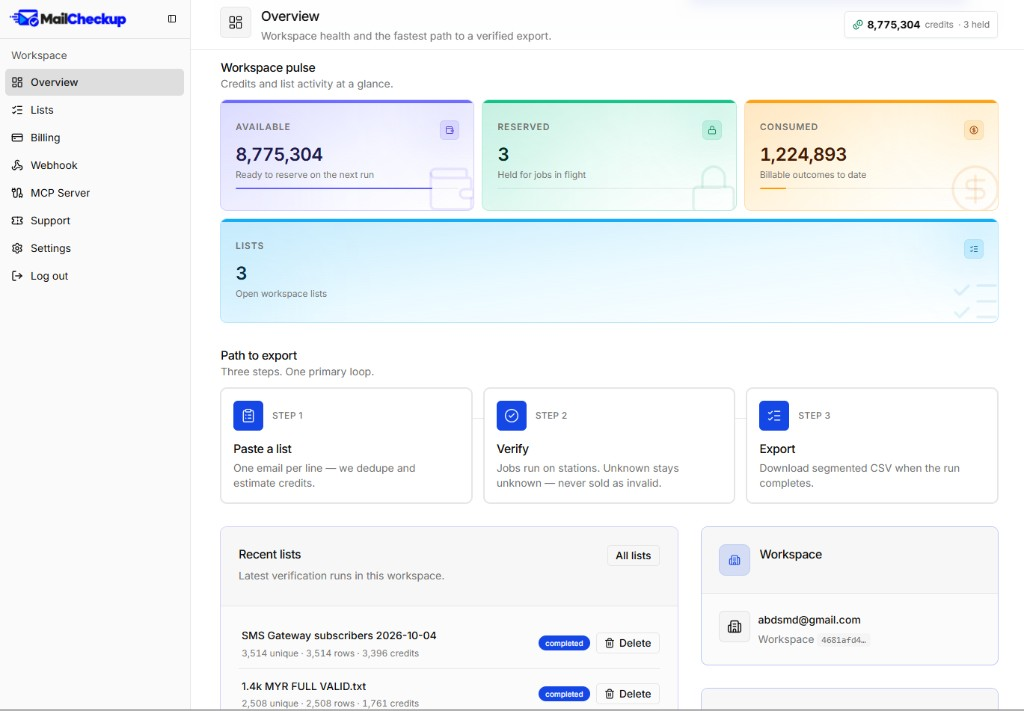
mck_), configure event-driven webhook callbacks, and monitor in-flight verification pulse across production applications.The SaaS signup dilemma: Frictionless onboarding vs. expensive abuse
Every software product manager understands the tension between signup velocity and data hygiene. Adding multi-step CAPTCHAs, forced credit card requirements, or synchronous email confirmation barriers introduces immediate drop-off, lowering user acquisition efficiency across paid and organic funnels.
Conversely, allowing unverified registrations exposes SaaS infrastructure to severe operational vulnerabilities:
Free-Trial Abuse & LLM Token Burn: AI applications granting free credits (e.g. OpenAI, Anthropic, Midjourney wrappers) are targeted by automated scripts using throwaway domains. A single fraud ring can cycle through 5,000 temporary inboxes in hours, running up thousands of dollars in unrecoverable GPU and cloud bills.
Transactional Delivery Blacklisting: When a new user signs up, your system immediately dispatches a welcome email, onboarding sequence, or magic link via Postmark, Resend, or SendGrid. If 8% of those addresses are dead or fabricated, your transactional domain gets penalized by Google Workspace and Microsoft 365, delaying password resets for paying enterprise customers.
CRM & Billing Seat Clutter: Bogus signups populate your Postgres database, trigger Hubspot and Segment webhooks, and inflate Active Customer Counts across Stripe Billing and Auth0, pushing your SaaS into expensive pricing tiers for phantom accounts.
MailCheckup resolves this trade-off by operating silently in the background: screening addresses in under 200ms, identifying burner domains from a 97,000+ domain repository, and failing open whenever upstream networks lag.
The 3-layer SaaS email defense architecture
Production engineering teams implement email hygiene through a layered defense model that balances user experience with operational security:
Layer 1: Real-Time Typo Assist (Client-Side Async): Catches common consumer domain typos (e.g., user@gmial.com or john@hotmial.com) on input blur before form submission. The UI surfaces an inline recommendation ("Did you mean @gmail.com?") without preventing the user from submitting if they insist.
Layer 2: Disposable & Burner Domain Quarantine (Server-Side Gate): Cross-references incoming email domains against our comprehensive 97,000+ temporary email blocklist, synchronized every 6 hours with authoritative community feeds. Disposable signups are blocked instantly with a friendly message: "Please sign up using your work or permanent personal email address."
Layer 3: Deliverability Verification vs. Identity Confirmation: MailCheckup checks RFC syntax, verifies domain MX routing, and tests mailbox existence via SMTP handshake. Deliverable addresses are provisioned immediately. If an address is flagged as risky (such as an unverified catch-all domain), your system can conditionally require an email confirmation link before granting access to sensitive platform features.
The fail-open principle: Why mission-critical SaaS must never block on timeouts
In high-availability web applications, third-party network dependencies must never create single points of failure. While MailCheckup resolves the vast majority of checks in under 180ms, certain recipient corporate mail servers deploy strict rate-limiting, DNS latency, or greylisting tactics that can take several seconds to respond.
If an API call exceeds your defined latency budget (e.g., 250ms–350ms), MailCheckup returns a graceful status: unknown response. Your application should always follow the Fail-Open Design Pattern:
1. Never Block the User: Immediately allow the registration to proceed, issue a JWT session token, and route the customer into your application dashboard.
2. Flag for Asynchronous Follow-Up: Record the user account with a temporary verification_pending flag in your database.
3. Automatic $0 Cost: MailCheckup automatically releases the held credit for any check that returned unknown or timed out. You never pay a single cent for inconclusive checks.
SaaS infrastructure ROI: Measuring abuse prevention vs. verification cost
Deploying pre-signup email hygiene yields immediate financial returns by eliminating cloud resource waste, third-party SaaS seat charges, and reputation repair fees:
| Monthly Signups | Disposable Infiltration (5%) | Prevented Free Trial Token/Compute Burn | MailCheckup Wholesale Cost | Net Monthly SaaS Savings |
|---|---|---|---|---|
| 10,000 / mo | 500 fake accounts | $550 / mo in wasted OpenAI tokens & infra | $25 / mo (10k pack) | +$525 / mo net profit |
| 25,000 / mo | 1,350 fake accounts | $1,485 / mo in compute, database & ESP costs | $45 / mo (25k pack) | +$1,440 / mo net profit |
| 50,000 / mo | 2,700 fake accounts | $2,970 / mo in free-tier infrastructure churn | $169 / mo (50k pack) | +$2,801 / mo net profit |
| 100,000 / mo | 5,400 fake accounts | $5,940 / mo in trial farming & CRM clutter | $279 / mo (100k pack) | +$5,661 / mo net profit |
| 250,000 / mo | 13,500 fake accounts | $14,850 / mo in scrapers & LLM trial burn | $549 / mo (250k pack) | +$14,301 / mo net profit |
By investing $25 to $549 in wholesale verification packs, SaaS businesses routinely eliminate $1,000 to $14,000+ in fraudulent infrastructure consumption, while protecting the deliverability of business-critical transactional notifications.
Technical architecture patterns: Selecting the right integration point
Depending on your product requirements, team constraints, and tech stack, MailCheckup supports four primary integration architectures:
| Architecture Pattern | Primary Objective | Latency Budget | Timeout & Fallback Policy | Ideal Tech Stack |
|---|---|---|---|---|
| Client-Side Form Blur | Catch user typos (@gmai.com) pre-submit | Async client (<200ms) | Silent pass-through (never block) | React, Vue, Next.js, Svelte |
| Synchronous Auth API Gate | Block 97k+ disposable burner domains | 150ms – 250ms p95 | Fail-open to unknown (0$ charged) | NextAuth, Express, FastAPI, Go |
| Asynchronous Event Queue | Enrich CRM & score leads post-signup | 0ms impact on user | Retry with exponential backoff | BullMQ, Celery, AWS SQS, Sidekiq |
| Signed Webhook Stream | Sync bulk user imports & org onboarding | Event-driven (push) | Idempotent event ID deduplication | Postgres, Supabase, Segment, Stripe |
Data privacy, SOC2 posture & GDPR Article 28 compliance
Security and compliance teams require ironclad assurances when routing user data through external verification services. MailCheckup adheres to strict data minimization and isolation policies:
Zero Contact Resale or Sharing: MailCheckup never retains, compiles, enriches, aggregates, or sells customer email addresses. Your user data remains your exclusive property.
Workspace Isolation & Scoped API Keys: API keys starting with mck_live_ are strictly isolated to your designated workspace. Requests from one tenant can never access or inspect verification runs from another.
Ephemeral Processing: In-flight address checks are processed in volatile memory and purged from operational caches following completion, aligning with GDPR Article 28 data processor obligations.
Frequently asked questions (Email verification for SaaS applications)
How fast is MailCheckup's API response for live SaaS signup forms?
Our single-address verification endpoint responds in under 180ms at p95. We achieve this sub-200ms latency by maintaining an in-memory radix trie of 97,000+ disposable domains, edge-caching authoritative DNS MX records, and establishing high-concurrency connection pools. For customer-facing registration forms, this ensures zero perceptible delay during the user onboarding flow.
What is the 'fail-open' principle, and why is it essential for SaaS products?
In Product-Led Growth (PLG) applications, conversion rate is sacred. If an external upstream mail server is experiencing network congestion, greylisting, or takes longer than your application timeout budget (e.g., 300ms), a mission-critical SaaS app must never block a legitimate buyer. MailCheckup returns a graceful status: unknown outcome. Your backend should fail-open: allow the user to complete registration, grant access to the product, and trigger a background verification link or delayed recheck.
How much does MailCheckup charge for 'unknown' or timed-out verification checks?
Unknown outcomes are 100% free ($0). When an address check results in a temporary timeout, greylist delay, or unreachable recipient server, the credit reserved during in-flight processing is automatically released back to your workspace balance. You never pay for inconclusive or incomplete verification outcomes.
How does MailCheckup protect SaaS apps against free-trial abuse and disposable email farmers?
Free-trial abusers frequently deploy disposable inboxes (such as Guerrilla Mail, 10MinuteMail, and burner services) to repeatedly consume free LLM API credits, cloud compute, or promotional perks. MailCheckup maintains an authoritative database of over 97,000 disposable domains, refreshed every 6 hours from GitHub repositories, security research feeds, and live DNS analysis, stopping burner signups before account provisioning.
Does real-time email verification replace double opt-in / confirmation links?
No. Email verification and confirmation links solve two complementary security problems. Email verification proves that an email address is syntactically valid, has active MX records, and can receive mail without hard bouncing. A confirmation link proves that the human sitting at the browser actually owns and controls that specific inbox. Combining both gives SaaS apps clean databases, low bounce rates on transactional welcome emails, and ironclad account ownership.
Can we verify emails client-side on input blur rather than in our backend route?
Yes. Many SaaS teams trigger an asynchronous check when the user leaves the email input field (onBlur). This allows you to surface instant, helpful suggestions for common typos (such as offering Did you mean alex@gmail.com? when the user types alex@gmai.com). However, we recommend enforcing a lightweight server-side check on your registration endpoint as well to prevent automated bots from bypassing client-side validation.
How do we integrate MailCheckup with Next.js, Node.js, Python, or Go backends?
Our REST API uses standard HTTP JSON requests with bearer token authorization (Authorization: Bearer mck_live_...). A single POST to https://api.mailcheckup.net/v1/check/single with {"email": "user@example.com"} returns a structured JSON object in under 200ms. You can implement this in 5 lines of code in Node.js (fetch), Python (requests/httpx), or Go (net/http).
Do purchased API credits expire if our SaaS signup volume fluctuates?
No. Credit packs purchased on MailCheckup never expire. If your signup volume experiences seasonal lulls or product release spikes, your purchased credits remain securely in your workspace balance indefinitely until consumed.