
The agency deliverability dilemma: Why clients blame you for dirty lists
When an agency signs a new outbound lead generation or lifecycle marketing client, the client frequently hands over an unvetted contact list scraped from LinkedIn, exported from an outdated CRM, or purchased from a third-party broker. The client assumes the list is "100% verified."
If the agency loads that list directly into cold sequencers (like Instantly or Smartlead) or marketing platforms (like Klaviyo or HubSpot):
Hard Bounces Spike Above 4%–8%: Google, Microsoft, and Yahoo transfer agents immediately throttle the sending domain, tagging all future outgoing mail as spam.
Secondary Domains Burn: Secondary sending domains that took 3–4 weeks to warm up become burned within 48 hours, costing the agency hundreds of dollars in domain repurchases and setup labor.
Client Trust Evaporates: The client blames the agency's copy, subject lines, or technical infrastructure rather than their own dirty data.
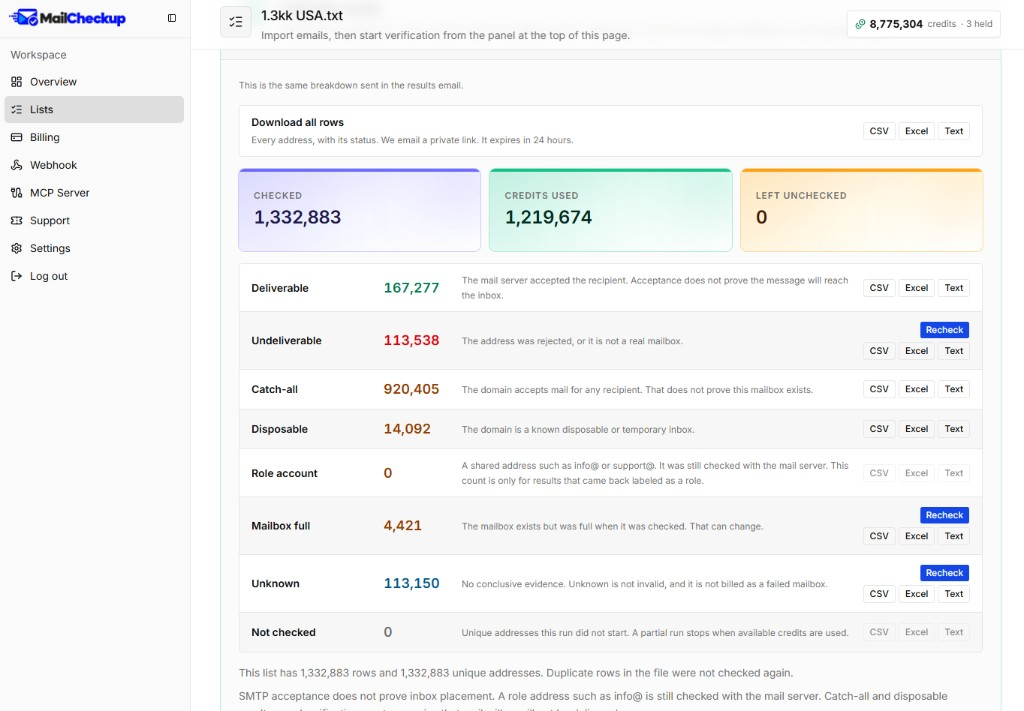
MailCheckup transforms this dynamic by enabling agencies to deliver an empirical, evidence-backed Client Pre-Launch Audit Report before sending a single email. When a client sees that 18% of their contacts were deactivated mailboxes or temporary disposable accounts, the agency looks like deliverability heroes who saved the client's domain from ruin.
Communicating technical verification outcomes to non-technical clients
Handing a client a spreadsheet with confusing technical codes leads to endless back-and-forth emails. MailCheckup categorizes results into clear, client-friendly buckets that agencies can explain effortlessly:
| Verification Category | Technical Finding | Agency Action | Client-Facing Explanation |
|---|---|---|---|
| Deliverable | Mailbox accepted recipient at SMTP handshake; active mail server | Import to active client sequence or ESP broadcast | Verified active inbox; safe to send with standard campaign metrics. |
| Disposable (Burner) | Domain matched against 97,000+ 6-hour GitHub blocklist | Quarantine; exclude from campaigns | Temporary burner inbox; will hard-bounce immediately upon address expiration. |
| Catch-All (Accept-All) | Domain accepts all emails during handshake without checking mailbox | Split into separate cautious sequence or review | Domain accepts all incoming mail; individual recipient cannot be guaranteed without sending. |
| Role Account | Functional address (info@, sales@, support@, team@) | Exclude from personalized outbound sales cadences | Shared department inbox; yields low individual engagement and higher spam complaint rates. |
| Undeliverable | Mailbox does not exist, domain has no MX, or syntax invalid | Hard suppress and remove from client billing | Confirmed dead mailbox; sending will trigger immediate 550 hard bounce. |
| Unknown | Recipient server timed out or greylisted our IP; no credit deducted | Retain and schedule re-check 24h later ($0 Free) | Mailbox server temporarily unavailable; held for automatic retry with zero credit cost. |
Agency wholesale economics: High margins, zero expiration pressure
Many verification tools force agencies into expensive monthly subscriptions where unused credits expire every 30 days. MailCheckup offers pay-as-you-go credit packs with no expiration dates, allowing agencies to purchase wholesale credits in bulk and draw from them across multiple client projects over months:
| Monthly Verification Volume | MailCheckup Wholesale Cost | Competitor Retail Cost ($0.010/check) | Agency Monthly Margin | Effective Unit Price |
|---|---|---|---|---|
| 25,000 Contacts | $45 (Pack credits never expire) | $250.00 | +$205.00 (82% margin) | $0.0018 / check |
| 50,000 Contacts | $169 (Pack credits never expire) | $500.00 | +$331.00 (66% margin) | $0.0033 / check |
| 100,000 Contacts | $279 (Pack credits never expire) | $1,000.00 | +$721.00 (72% margin) | $0.0027 / check |
| 250,000 Contacts | $549 (Pack credits never expire) | $2,500.00 | +$1,951.00 (78% margin) | $0.0021 / check |
| 500,000 Contacts | $949 (Pack credits never expire) | $5,000.00 | +$4,051.00 (81% margin) | $0.0018 / check |
By purchasing credits at wholesale rates ($0.0018 to $0.0027 per check) and either bundling verification into monthly client retainers ($500–$1,500/mo) or billing clients at standard retail rates ($0.010/check), agencies generate healthy profits while ensuring zero client domain casualties.
Data privacy, workspace isolation & GDPR Article 28 compliance
Agencies manage proprietary lead databases across competing clients. A security slip or cross-contamination between client lists can result in catastrophic legal liability. MailCheckup enforces strict data governance designed for agency operations:
| Data Protection Dimension | MailCheckup Agency Standard | Legal & Regulatory Impact | Agency Client Benefit |
|---|---|---|---|
| Workspace Segregation | Individual API keys (mck_) isolated per client workspace | GDPR Article 28 (Processor obligations) | Zero risk of accidental cross-client list contamination or data mixing. |
| Data Minimization | Only email addresses processed; unnecessary PII stripped | GDPR Article 5(1)(c) | Limits client liability and exposure under data protection audits. |
| Zero Data Reselling | Client lists are never aggregated, scraped, sold, or shared | CCPA/CPRA & FTC Fair Information Practices | Protects agency trust; guarantees client proprietary lead data remains confidential. |
| Export Retention Policy | Audit downloads expire automatically after retention window | GDPR Article 5(1)(e) (Storage limitation) | Eliminates long-term breach risk and orphan file exposure. |
Multi-client automation: API, Webhooks & native AI MCP server
Scale agencies cannot afford manual CSV uploads for dozens of clients every week. MailCheckup provides modern programmatic integration options:
Automated Webhook Callbacks: Configure an HTTPS endpoint. When a bulk list check finishes, MailCheckup securely POSTs a signed JSON payload with category counts and a pre-signed download URL, automatically triggering downstream sequencer imports in Make or Zapier.
REST Verification API: Single-address endpoint allows agency developers to verify incoming leads from client landing page forms in real time before creating CRM records.
Model Context Protocol (MCP) Server: Agency AI agents running in Cursor, Claude Desktop, or ChatGPT can autonomously inspect, verify, and filter client lead batches via structured JSON-RPC 2.0 tool contracts, removing human busywork from the agency workflow.
Frequently asked questions (Email verification for agencies)
Can our agency white-label or export raw client audit reports?
Yes. MailCheckup allows you to download clean, segmented CSV and Excel files containing comprehensive verification fields (status, sub_status, is_deliverable, is_disposable, checked_at) without vendor branding. You can brand the data and present it directly to clients as your proprietary deliverability audit deliverable.
How should our agency bill email verification to clients?
Most successful lead generation and outbound agencies bundle verification into their monthly client retainer as a "Domain Health & Deliverability Guarantee." Other agencies bill clients a pass-through cost at standard market retail rates ($0.010 per contact), generating substantial margins on wholesale MailCheckup packs ($0.0018 to $0.0027 per check).
What should we tell a client who insists on emailing catch-all addresses?
Explain that catch-all domains accept all incoming emails during initial SMTP connection without verifying whether the specific person exists. If a client insists on mailing catch-all contacts, advise them to send only to verified deliverable contacts in primary campaigns, and test catch-all addresses in a separate, low-velocity sequence using secondary disposable inboxes.
How does MailCheckup prevent cross-client data leaks in agency workflows?
Each list run is isolated within its specific workspace. API keys starting with mck_ are scoped strictly to the workspace that generated them. MailCheckup never blends, aggregates, cross-references, or shares customer data across different workspaces or clients.
Do agency credit packs expire between client campaigns?
No. Credit packs purchased on MailCheckup never expire. If a client pauses their retainer or delays campaign launch, your purchased credits remain in your balance indefinitely until consumed across future client batches.
How do unknown or greylisted results affect our agency credit balance?
Unknown outcomes—such as when a client's recipient mail server temporarily times out or greylists our connection—are 100% free with zero credits deducted ($0). The temporary credit hold is released automatically, ensuring agencies never pay for inconclusive results.
Can our agency automate list verification directly from client Google Sheets or CRMs?
Yes. You can use our signed webhook callbacks and REST API with workflow automation platforms like Make.com, Zapier, or n8n to automatically pull contacts from a client Google Sheet, verify them in MailCheckup, and update verified statuses automatically.
How does pre-send verification protect cold outbound secondary domains?
Mailbox providers like Google and Microsoft enforce strict thresholds: hard bounce rates exceeding 2% trigger automated domain throttling. Pre-verifying Apollo or scraped leads removes dead mailboxes and 97,000+ disposable domains, keeping bounce rates strictly below 1% and saving warmed-up secondary domains from blacklisting.